
A Stormbringer 4th Edition Scenario written by Geoff Gillan & illustrated by John T . Snyder
He is dressed oddly, with heavy green boots and quilted red breeches and jerkin. Beneath the jerkin is an emerald green silken shirt. A yellow jewelled belt holds a silver dagger and long silver sword, delicate and thin. A sodden red and green cap droops on his head, and his pale, fine hair is plastered to his face. Rainlashed and on the point of exhaustion, he staggers from side to side, at first appearing to dance some strange unfathomable steps, then drops from exhaustion upon the bridge.
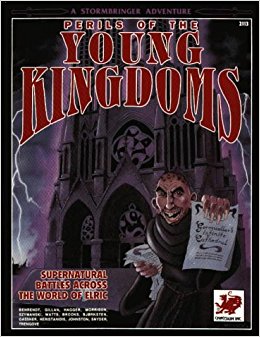 The Man Who Sold Gods is the fifth and final scenario from one of my all-time favourite Stormbringer supplements, Perils of the Young Kingdoms. Released by Chaosium Inc. in 1991 and written by the underappreciated1 Geoff Gillian, it includes illustrations by the equally iconic John T . Snyder. Sixteen pages in length, it is an adventure couched in high strangeness and amusing oddities, demonstrating the oft-frenetic, new-wave, gonzo aspects that really lie at the heart of Michael Moorcock’s Eternal Champion multiverse.
Please note, as with all such scenario reviews on the Stormbringerrpg.com site, these commentaries are the opinion of their author only, and are rated in three simple categories – Must Run, Should Run, Might Run (see the sidebar below for more information on these ratings).
The Man Who Sold Gods is recommended as a Must Run scenario.
Scenario Overview
The Man Who Sold Gods can be set anywhere in the Young Kingdoms and acts as a great transitional scenario, allowing the Game Master to fill in the gap between other stories in a larger Stormbringer campaign. An adventure of two distinct halves, it begins as a not-so-subtle initiation to the wider multiverse, with the introduction of the Vadagh Prince Rorn Feldun Harai, while finishing as a madcap encounter in a flying cathedral that really shouldn’t exist. You read that right: this scenario combines aspects of the world of Corum with an interdimensional church where strange and exotic gods can be ‘purchased’, so you should probably already be getting a feel for where this review is going.
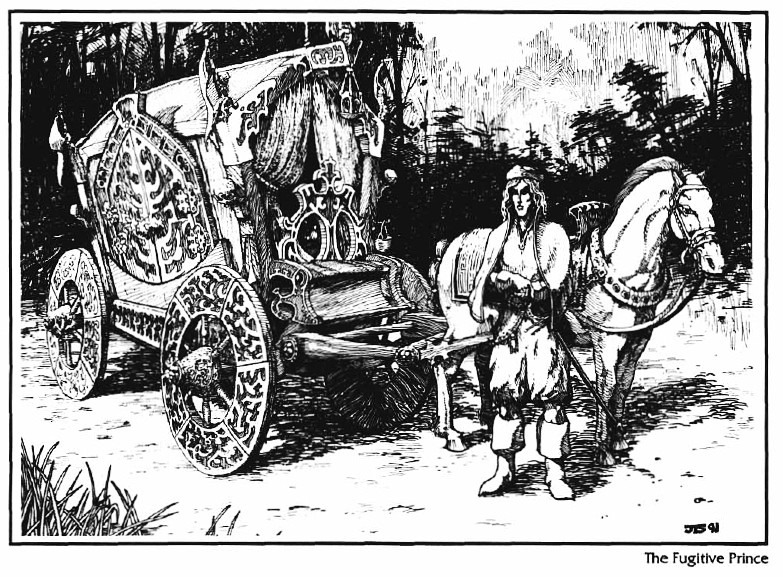
Trapped and hunted in the world of the Young Kingdoms, Prince Rorn remains but one step ahead of the Chaos Lord, Queen Xiombarg of the Sword Rulers and her army of man-thing warriors. Encountering the party amid a storm of colour and light, Rorn throws himself at the mercy of the heroes, as Xiombarg’s foul Chaos Pack closes in. With the threat overcome, the Vadagh reveals himself and regales the characters with the tale of his doomed people and their war against the Nadragh. Hopefully convincing the party to aid him further, Rorn explains that Gormweller, the Theomerchant and owner of the multiverse-hopping Infinite Cathedral, is to blame for Xiombarg’s influence in the Young Kingdoms. Only by capturing the cathedral will Rorn have a way to get home (and, in addition, eliminate one way the Queen of Swords’ forces have of entering this sphere.
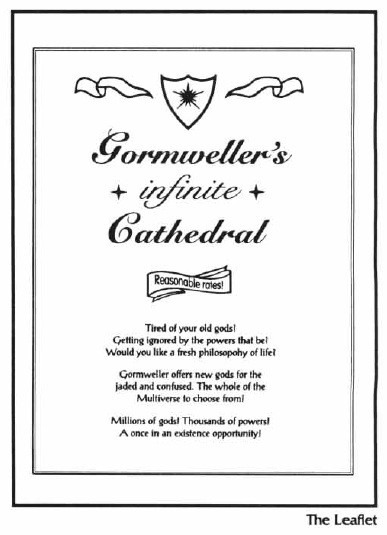
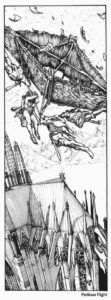
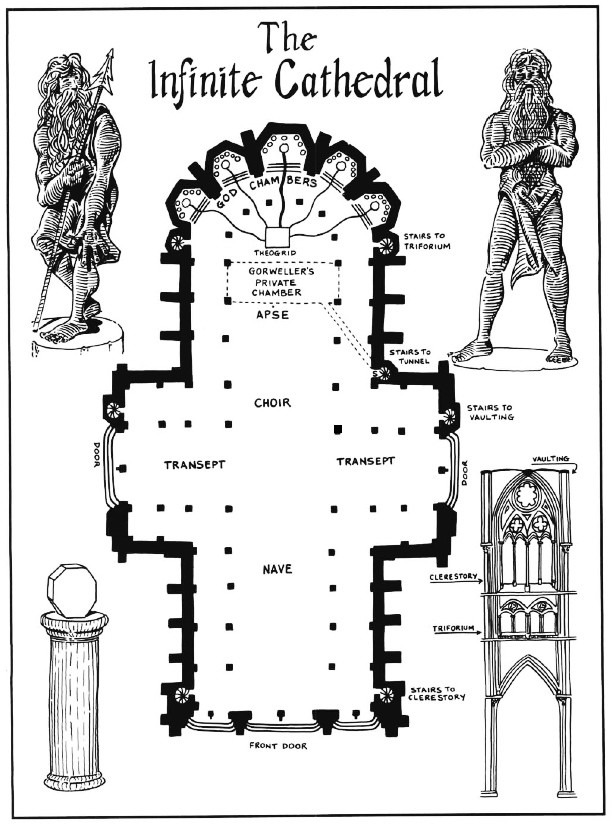
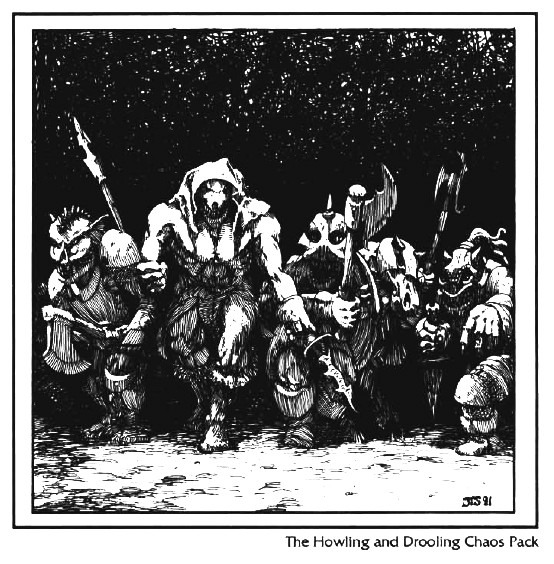 With the Chaos Storm growing ever larger, Rorn proposes performing the Terpsichorean Canticle, a ritual dance that will call forth the Infinite Cathedral. Amid the madness of further assaults, a complex dirge and the arrival of one of my favourite NPCs of all time, Nysh the Leafleteer, the party will witness the arrival of an immensely strange medieval cathedral of black and white glass upon a nearby lake. Trapped and surrounded by the power of the storm and closing forces of Xiombarg, the heroes are forced to gain entrance to Gormweller’s craft via the craziest situation I think I’ve ever seen in a Stormbringer game – the Leaflet Kite. This flying device, built by the party out of the many scattered leaflets announcing the Theomerchant’s offerings, and whatever else they can scourge, allows the group (including Rorn) to glide over the heads of the ravening horde and breach the cathedral! Tell me that’s not a provocative scene?
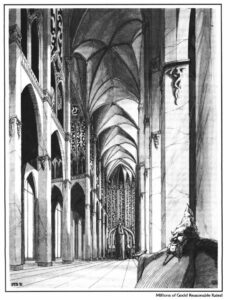
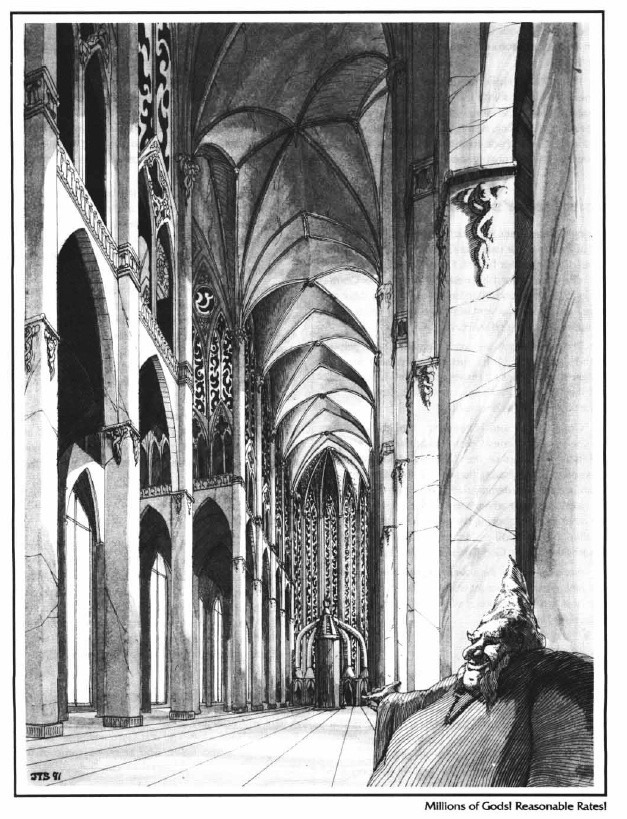
 Once within the Infinite Cathedral, the heroes will not only get to explore the strange building but also meet the legendary Gromweller – Short and fat, almost twice as wide as he is high. He wears a plain gold robe, slippers, and black pearls around his neck. His hair is blue and teased into a tall spiral on the top of his head, while flourishing blue whiskers impinge on his cheeks and threaten to poke into his mouth. He laughs often and without forcing, and speaks in a mellifluous, humorous tone. He is expansive with his gestures and his adjectives.
How this story ends is up to the characters. Will they look to buy a new God to worship, or will they fight for or against the Theomerchant? Will they betray Prince Rorn and destroy the cathedral’s Theogrid, or is the acquisition of a multiverse-hopping church an opportunity too good to pass up? Whatever the outcome, the conclusion of The Man Who Sold Gods is bound to be an epic and fun session that the players will talk about for years!
Why is this a Must Run Scenario?
Across all of the published Stormbringer scenarios, except perhaps the epic Rogue Mistress (Ed. I promise I will get around to reviewing THE Stormbringer campaign) at some point… just don’t hold your breath), none are quite as strange or unique as The Man Who Sold Gods. Where the majority of the game’s adventures play it pretty straight in regards to the setting, events and outcomes, this scenario feels the most like Moorcock himself might have had a hand in sketching its outline. Not only is one of these increasingly rare stories that can just be run anywhere, but it also does a lot to tease the wider multiverse, which moves Stormbringer from being simply a dark fantasy RPG to an epic game ripe for cosmic adventure. It is also nice and short, and can easily be run over a single session, if so desired.
I think also that The Man Who Sold Gods is a good inspiration for one’s own scenario writing, as it moves away from the more forlorn and sometimes futile feeling stories where the characters, much like Elric himself, are victims to the whims of Mistress Fate, and instead can forge their own solution to the story.
And let’s not forget good old buck-teethed Nysh the Leafleteer… one hell of a fun NPC!
Rating Categories
Arranging and running sessions of Eternal Champion roleplaying can be difficult in this day and age, and it is hoped that through the material and reviews on this website, potential Game Masters can be assisted in making the best choices for their sessions. To this end, we categorize each scenario we review in the following manner:
Must Run – These are the most interesting and iconic adventures written for Stormbringer in all its guises. They aren’t always the best written or presented, but in the opinion of the reviewer, they highlight the concepts, plotting and styling that make the Eternal Champion’s multiverse such a unique setting for gaming. To these ends, we believe these scenarios should be run first and foremost in any new Stormbringer session or campaign.
Should Run – While all published Stormbringer adventures bring interesting or iconic elements to life on their pages, not all are the easiest to prepare or run. Some have failed to age gracefully and may need more than a few tweaks to meet the expectations of the game table. In short, all these scenarios are great but may need some TLC before play.
Might Run – Fortunately, few published Stormbringer scenarios fall into this category, but those that do – in the opinion of the author – lack the elements that distinguish them from those available for other roleplaying game systems. That’s not to say that they aren’t without any merit, but as a Stormbringer Game Master, you may only wish to run these after the other categories are exhausted.
Issues or Constraints
 Of course, the scenario isn’t without its other considerations and limitations, and the following outlines a few of my concerns for any prospective GM.
- Constraints of Opening Scenes – Even as you read through the scenario, it should be fairly obvious that the first half of the scenario, while providing a fun, if slightly mad-capped plot, doesn’t actually allow much for the characters to do. They are, for all intents and purposes, passengers from the opening of the scenario, relying on Prince Rorn to fill in all the details. From the time they meet the Vadagh Prince, they are pretty much forced to follow his lead (be it in defending him from Xiombarg’s Chaos Horde, assisting him in the ceremony to summon the Infinite Cathedral or building the kite). It’s only after they break into the multiverse-travelling building that they really get their autonomy back
- The Risks of Owning a Spaceship – Giving the characters access and control over the Infinite Cathedral might be a step too far. What the heroes might do with such a plane-hopping craft (as in other adventures or encounters) isn’t really discussed in the scenario’s text. At best, these tools might be used to quickly get the characters to another continent or location somewhere in the young Kingdoms. Still, I’d be loath to allow them to keep either the cathedral or any of Gromweller’s artifacts for an extended period of time.
- Managing the Battles – One thing I haven’t spoken too much about is the number and challenge of the opponents encountered in the scenario. Not only are there quite a lot of them, ranging from Dragcloven and Xiombarg’s chaos pack, through the Queen’s well-armed mercenary band, and those on the Infinite Cathedral, but some will be deadly to even the most well-prepared party. Gromweller’s Avatar alone would be more than a fight for a small party, never mind some of the God Avatars the Theomerchant can bring to life. All these fights have the potential to be thrown at the party in pretty quick succession, with little chance to heal or rest. As such, the GM, unless they are looking for a Total Party Kill, should consider carefully how they want these fights to unfold.
Suggestions in Play
Here are a few thoughts on what I would do or plan if I ran this scenario again.
- Know what you want from the Scenario – As mentioned, The Man Who Sold Gods works best as an interlude-style scenario, and I’d suggest the GM determines how they best want to use this type of storytelling beforehand. The adventure can be equal parts deadly and railroaded, so it may not appeal to more modern roleplayers, especially once the antics with the Terpsichorean Canticle and cathedral come to play. Planning out Prince Rorn’s plans might help, as would prewarning in some manner the powers of the Theomerchant and his Gods.
 The Power of Gods – Talking of the power of the Gods, more than a dozen avatars are noted in the scenario’s text. These provide plenty of opportunity to throw even more confusion and fun into the mix, beyond creating yet another opponent to ‘kill’. There is some information on ‘selecting a new god’ in the adventure (and the financial cost of such devotions), but wouldn’t it be more fun to have all these competing powers fighting (in a spiritual sense) over the characters? There is so much more opportunity beyond fighting, and a GM would be foolish to have the scenario conclude in such a fashion.
- Building up the Beginning – Prince Rorn is one of the last of the Vadagh, a doomed people whose story is told in the Corum saga. As written, Rorn acts a little bit like an exposition dump, where he has a story and plans that are just thrown at the characters in between fights. This is a missed opportunity; the prince, his knowledge and even his wondrous carriage need time to breathe and grow. Perhaps the party encounter the chaos pack attacking Prince Rorn and must nurse the wounded stranger back to health over a period of days or weeks, or even as they go about other adventures? Slowly, the Vadagh’s story can be revealed, and an escape from the sphere of the Young Kingdoms planned. Wouldn’t that be so much more satisfying than banging this whole plot into one mad in-game evening?
Final Notes
I didn’t really discuss this earlier in the review, but I love John Synder’s art throughout. Despite there being only 4 images, all of them are impressive and evocative (I’ve scattered them throughout this post so you can see them for yourself).
Beyond that, I think I’ve said everything I can about The Man Who Sold Gods. It’s an inspiration for my own scenario writing and a bit mind-blowing, both as a player and a GM, when playing through it. I also love the fact that it’s my old mate, Nysh, who gets to grace the cover of the entire Perils of the Young Kingdoms book

- Or at least, I will admit, I’ve not appreciated just how much Geoff contributed to the line along with his fellow Aussies Mark Morrison, Richard Watts and, from a perspective of scenarios I enjoy, Nick Hagger. This scenario, more than any, has influenced many of my homebrew adventures, some of which I hope to write up for this site one day. ↩
Leave a Reply